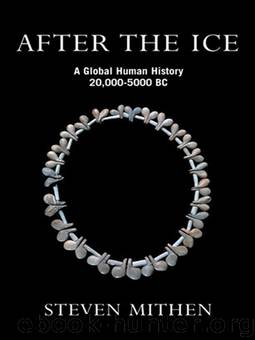
After the Ice: A Global Human History, 20,000 - 5000 BC by Steven Mithen
Author:Steven Mithen
Language: eng
Format: mobi, epub
ISBN: 9781780222592
Publisher: Orion Publishing Group
Published: 2011-12-08T07:00:00+00:00
40
With the Jomon
Complex hunter-gatherers in Japan and the earliest pottery, 14,500–6000 BC
Everybody stops, looks up and stares in silence. For a brief moment John Lubbock’s feeling of ‘otherness’ from his new, unknowing hosts is lost. Rumbling, smoking volcanoes have that effect – emotional responses swell up to override cultural differences. But within an instant it has passed. The people of Uenohara are once again watching and listening to the distant volcano through their own cultural filter – their mythology and ideological beliefs about which Lubbock knows nothing. As voices and the sounds of work begin again, he resumes his status as observer rather than participant in life on Kyushu island, in Japan, 9200 BC. Lubbock has arrived at Uenohara 2,500 years before he left the Yangtze at 6700 BC.1
Uenohara is a village on the southern coast of Kyushu, at the head of what is now known as Kagoshima Bay.2 Its occupants are hunter-gatherers – the ideas and seed-grain for rice cultivation that will spread eastwards along the Yangtze valley from Pengtoushan will not arrive in Japan until 5000 BC at the earliest.3 To reach the village, Lubbock had trekked through the island’s thickly wooded hills after his own arrival on its western shore. A maze of tiny paths took him between oaks and chestnuts; the air was pungent with autumn, the boughs heavy with their seasonal load.4 He soon discovered unseen companions in the woods by recognising deer tracks in the mud, pig hair on brambles and axe-marks on tree stumps. The paths led him to a clearing with a scatter of thirteen conical huts. It was mid-afternoon; adults were busy tending fires and manufacturing tools, while the village’s children chased each other round the dwellings.
A party of the Uenohara people had also just emerged from the woods carrying bundles of reeds and sacks that bulged with the produce of the forest. Lubbock guessed that the reeds were for a new hut whose skeleton of wooden poles had already been tied into a wigwam shape around a circular depression.5 Several men were felling trees with stone axes to enlarge the clearing. Their work exposed a view across the sea, revealing a distant mountain with its summit surrounded by cloud – or so Lubbock had thought until it rumbled and a new plume of ash-laden smoke issued forth.
The people of Uenohara looked fit, healthy and happy. They wore few clothes. The children and some adults went bare. Most had nothing more than an apron of hide around their waist; a few wore tunics. All except the very old had vibrant yellow-brown skins with jet-black hair either tied into plaits or swept back below headbands. Some wore necklaces made from deer teeth and boars’ tusks; a few men had swirls of red paint upon their chests.
Just as at Pengtoushan, Lubbock was drawn to sit next to a potter – this time an elderly lady with wrinkled skin and no teeth. She was completing a vessel far more elegant than any Lubbock had
Download
After the Ice: A Global Human History, 20,000 - 5000 BC by Steven Mithen.epub
This site does not store any files on its server. We only index and link to content provided by other sites. Please contact the content providers to delete copyright contents if any and email us, we'll remove relevant links or contents immediately.
| Africa | Americas |
| Arctic & Antarctica | Asia |
| Australia & Oceania | Europe |
| Middle East | Russia |
| United States | World |
| Ancient Civilizations | Military |
| Historical Study & Educational Resources |
The Daily Stoic by Holiday Ryan & Hanselman Stephen(3322)
The Fate of Rome: Climate, Disease, and the End of an Empire (The Princeton History of the Ancient World) by Kyle Harper(3067)
People of the Earth: An Introduction to World Prehistory by Dr. Brian Fagan & Nadia Durrani(2738)
Ancient Worlds by Michael Scott(2688)
Babylon's Ark by Lawrence Anthony(2679)
The Daily Stoic by Ryan Holiday & Stephen Hanselman(2575)
Foreign Devils on the Silk Road: The Search for the Lost Treasures of Central Asia by Peter Hopkirk(2464)
India's Ancient Past by R.S. Sharma(2454)
MOSES THE EGYPTIAN by Jan Assmann(2417)
The Complete Dead Sea Scrolls in English (7th Edition) (Penguin Classics) by Geza Vermes(2283)
The Earth Chronicles Handbook by Zecharia Sitchin(2229)
Lost Technologies of Ancient Egypt by Christopher Dunn(2226)
24 Hours in Ancient Rome by Philip Matyszak(2084)
Alexander the Great by Philip Freeman(2065)
Aztec by Gary Jennings(2031)
The Nine Waves of Creation by Carl Johan Calleman(1917)
Curse Tablets and Binding Spells from the Ancient World by Gager John G.;(1862)
Before Atlantis by Frank Joseph(1857)
Earthmare: The Lost Book of Wars by Cergat(1825)
